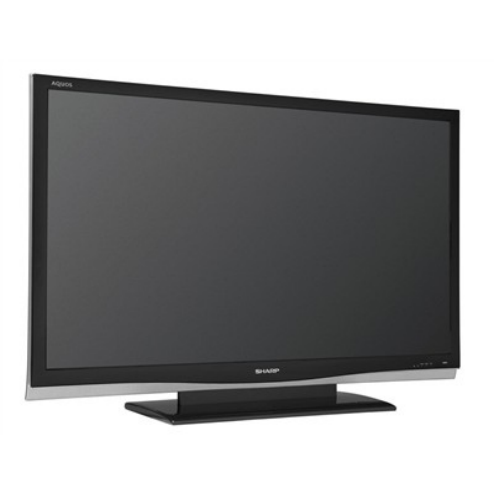
6th Avenue Electronics has the Sharp AQUOS 32" 1080p HDTV for $699, including shipping, with a coupon. It's the lowest price we've seen for this LCD by about $100, and it's a pretty well-reviewed line. This one features a 6ms response time and dual HDMI inputs.
[Via: Gizmodo, The Gadget Blog ]
[Tag: ]
Showing posts with label TV. Show all posts
Showing posts with label TV. Show all posts
Dealzmodo: Sharp AQUOS 32" 1080p LCD for $699 Shipped [Dealzmodo]
Story of a Peanut: The TiVo Remote's Untold Past, Present and Future
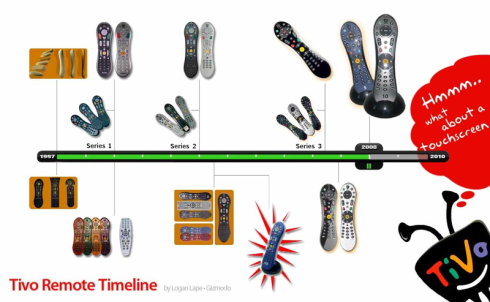
I recently had the opportunity to learn more about TiVo’s award-winning remote control when I met with their Senior Director of Consumer Engineering Paul Newby, father of the TiVo remote. Aside from hearing the story of how the remote slowly sprouted into the "Peanut," I found out some unknown stories behind the clicker. Stuff like TiVo butting heads with Sony, rare remote colors that no one outside TiVo will ever own (or see until now). Or how the remote could get a QWERTY or lose all its buttons in favor of a touchscreen. As I sat down with Paul and began to weed through containers of foam molds and old remote prototypes, I asked him to start from the beginning and explain how TiVo had turned a Peanut into one of the world's most loved remotes. History & Design
By the spring of 1998, TiVo was developing what we all know now as the DVR. During the design stages, their designers knew they would not only need to create a DVR that was extremely functional, but also a corresponding remote control that would allow seamless and intuitive use. This is where Paul Newby enters. “I came to TiVo when we were still called Teleworld, and when we started off we grabbed off-the-shelf remotes. These remotes had multiple rows and columns of keys, and it was clear this wasn’t going to work. What we decided to do early on was make a remote that grabbed attention off the coffee table.” When Newby pushed his designers to create a remote that would stand out, he was shocked by the initial designs. The reasonable ones resembled items like a bread-stick or a spatula, but there were few that were so crazy they looked more like a toad. There was one designed that was nicknamed the Peanut. Once a few foam prototypes were made, the designers called the shape a success. “It became obvious early on that to achieve the seamless trick play and control we were after for our new PVR/DVR creation, the remote must be comfortable for long periods of in-hand use. This and an iconic look, were motivations for the more distinctive, organic, peanut shape.” This peanut shape saw slight variations from mold to mold, with some that were wafer thin to others that were more like a thick slab. With the final prototype, designers and the TiVo team felt that a medium amount of curve was the best for a remote. Once the shape had been finalized, the designers and engineers began tackling other details to the remote. Aspects like button layout and electronics were now on the drawing board. But throughout the tedious work of refining, the designers began to poke fun at the decision they made. “There were a lot of jokes about the shape. Not just the obvious ones,” said Newby. “I can remember some referencing to an earlobe, or the shape of the lower back/butt area." Like any remote, the designers were adamant about keeping the remote’s button layout as simple as possible. But with the DVR’s numerous features, the designers needed to create lots of extra buttons. To keep things straight, each button needed to have a distinctive feel, giving the ability to control the remote without even looking at it, which Newby described as a “key Braille-ability" surprisingly helped by the "blank finger parking spots between keys" that were equally important. Eight and a half months after the team started in July 1998, the first remote was done. Throughout the whole design process, Newby continually told his design team to try anything, but to always keep two things in mind. “Number one, get up from the desk, and number two, be ready to endure someone telling you in less than an ideal way that your baby stinks.” Without knowing it, Newby’s last bit of advice was crucial when TiVo started to work with other manufacturers who were reluctant to use this strange Peanut remote. Dealing With Manufacturers
At this point, TiVo's designers felt that they had developed one of the most ingenious remotes on the market. Sadly, when TiVo began working with manufacturers such as Sony and Hughes (Direct TV), they did not feel the same. “The process was very very very, frustrating and quite frankly, I was surprised.” Because some of the manufacturers didn’t want to use the Peanut shape at all, the TiVo decided that if a different remote was going to be supplemented, it had to have some core requirements. A big yellow pause button and characterize thumb buttons were a necessity. But as hard as TiVo pushed, these were the exact type of buttons that the manufactures insisted against. “Using a bright color on remotes was not something that these companies did. Anything thing with character images on it, the companies didn't want to use.” In the end there was consensus, but it wasn't easy getting there. Series Updates
With each Series update the Peanut saw a slight change in design. “We’ve toyed with other shapes in the background but always come back to the peanut. The subtle shift from Series 1 to Series 2 allowed more free space between keys, space for partner branding, and improvements for manufacturability. The shift to Series 3 made refinements in key snap, backlight, fore/aft directionality, and balance.” During the change from Series 1 to Series 2 there was an interesting internal change that many users never knew about. “We set the IR emitter power fairly high on the early Series 1 production remotes. This had the effect of being able to control TiVo from any number of off angle positions. It also turned out that, in some cases, a user could even drape themselves and the remote completely in a blanket, yet still blast through the blanket to control TiVo.” Among designing and updating the remote, this concern for battery life would stay as a major concern for adding features. For example, Newby's team has a Series 2 remote that was back-lit, but backed off because of power concerns. With a back-light feature finally being added to the Series 3 remote, the team decided to use 4 AAA batteries rather than 2 AAs. (As a bonus, the heavier remote had a better center of gravity.) The batteries offset some of the power drain, but there is also a slight decrease in life, even with the light sensor selectively enabling the remote's illumination. Even within the Series 3's lifetime the Peanut remote has seen some changes. When the first Series 3 remote shipped with the Series 3 TiVo, it had a painted gray bezel. Now that the Series 3 TiVo is being killed off for TiVo HD, TiVo’s flagship remote is the Glo remote. The major different between the original Series 3 remote and the new Glo remote is the bezel, which is now a shiny chrome which is cheaper to make. Rare Remotes
Among the various colors of remotes that were produced, there are a few that were far less common. For the first version of the remote, TiVo made a translucent array of colors that mimicked their logo's color. Sadly though, these remotes never actually made into the public's hands. The rarest of them all is a rubberized blue five-year remote. This remote is only given to employees who have worked with TiVo for more than five years. More of an award than actual remote, it even has its own stand that displays it proudly. This remote was originally made in a rubberized Series 2 form, but has now been updated to the non-rubberized Glo form. In the same vein as the five-year remote, there is now a 10-year. “My team is working on a 10 year remote, and we're right on the cusp.”
“It will be a permutation of the Glo in a steel blue color.” Future
With TiVo continually adding features to their DVRs, there is a growing need for a remote that will complement new features. The TiVo design team has acknowledged this, and Newby assures that they are are always working on improvements. "There's probably about two and half of us at any given time designing the next remote." With the next generation TiVo remote on the drawing board, I wondered what the possible additions could be. When I asked if adding a small QWERTY keyboard was a possibility for the next generation, I was surprised by Newby’s answer. "Let me just say we're ping-ponging the idea. You wouldn't be disappointed." If they had given the idea of adding a keyboard though, then I figured I had to ask if there was possibility of incorporating a touchscreen for future use. Once again Newby’s response sparked my interest. "We've either given it thought or were in the process of prototyping it. I'd say it's a healthy combination of both never been done, done before and what's been done well elsewhere." "So you name it, were thinking about. But we are carefully at what we throw at it." Also, thanks go to Danny.
[Via: Gizmodo, The Gadget Blog ]
[Tag: ]
The SMK Television Remote is Funky and Battery Free
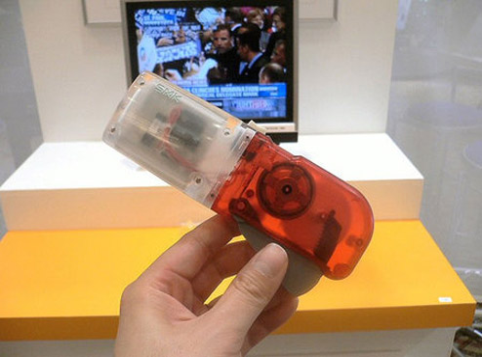
Sure it looks weird, but this little prototype remote from SMK operates without the use of battery power. Like similar flashlight-type devices, this remote uses a electromagnetic induction coil to generate electricity when the user pulls the trigger. Pulling the trigger once will change channels, two pulls will turn the TV on or off, and the volume can be controlled by pulling the trigger and pushing a separate button at the same time. Personally, I'm going to need a little more features built into this thing before I decide to make the switch, but eco-friendly types with weak grips may find it to be of some use. [Fareastgizmos]
[Via: Gizmodo, The Gadget Blog ]
[Tag: ]
Inca's TV Mount With Automatic Pull-Out and Swivel Features [Home Entertainment]
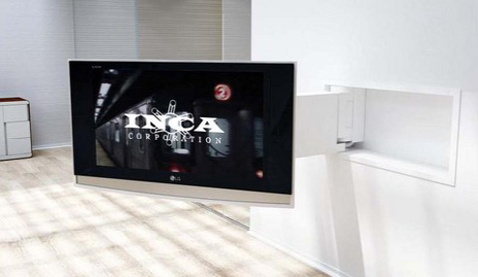
Automatic TV mounts are nothing new, but this new design by Inca is intriguing with its remote controlled pull-out and swivel features. Instead of simply tilting from side to side, Inca's version can also be moved nearly flush with the wall, or out for clear views from extreme angles. According to Inca, the P/N 900810-5A-WPS "Off the Wall" system should accommodate most TV sizes. Unfortunately, pricing and availability information has yet to be released. [Inca via Electronic House via Gearlive via Freshome]
[Via: Gizmodo, The Gadget Blog ]
[Tag: ]
Panasonic Prices 2008 Flagship PZ850 Plasma HDTV Line, Demos Viera Cast IPTV [TV]
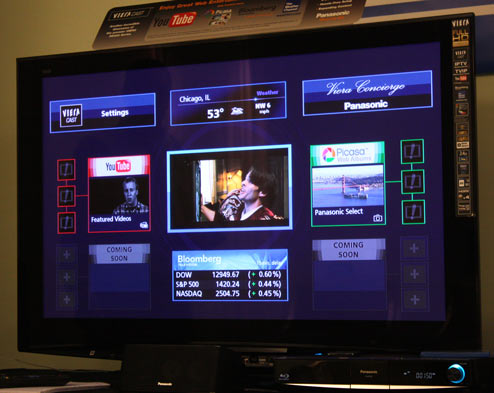
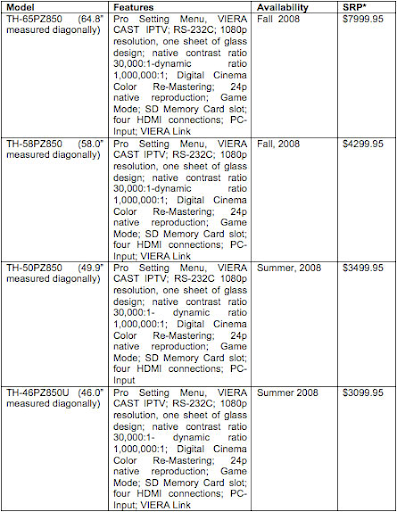
PANASONIC ANNOUNCES AVAILABILITY OF ITS FIRST VIERAВ® CAST WEB-ENABLED PLASMA HDTVYouTubeв„ў, Google's Picasaв„ў Web Albums and Bloomberg Sites Accessible Directly On-ScreenSecaucus, NJ, (May 20, 2008) - Panasonic, the industry leader in High Definition Plasma TV, announced today that its much-anticipated web-enabled PZ850 series of VIERA Plasma HDTV's will be available at retail beginning in mid-June. The flagship line's wide range of cutting-edge features is highlighted by VIERA CAST which provides access to some of the most popular content sites on the Internet today - YouTube, Google's Picasa Web Album and Bloomberg. The VIERA line was initially previewed at the 2008 Consumer Electronics Show in January 2008.Panasonic's VIERA 1080p PZ850 series offers features designed for the most demanding videophile - enhanced contrast ratio, deeper blacks, faster response time and outstanding picture quality in four screen sizes - the 46-inch class TH-46PZ850 (46.0" measured diagonally), the 50-inch class TH-50PZ850 (49.9" measured diagonally), the 58-inch class TH-58PZ850 (58.0" measured diagonally) and the 65-inch class TH-65PZ850 (64.8" measured diagonally). Coupled with Panasonic's new VIERA CAST technology, the PZ850 series will give consumers on-screen access to a far broader range of unique content than ever before."Our VIERA PZ850 series really takes connectivity and home entertainment to a whole new level for consumers," said Bob Perry, Senior Vice President, Panasonic Consumer Electronics Company. "In addition to delivering stunning, true-to-life High Definition movies and television programming that all of our VIERA HDTV's are famous for, our PZ850 series also allows you to seamlessly access an unending supply of content via the web via You Tube and Google's Picasa Web Album websites. Another terrific enhancement for the consumer is that when new web sites become available they will be automatically available on the TV."Imagine being able to press a button and see a family member's photos from their vacation right on your own large-screen Plasma or enjoy one of the many intriguing videos found on You Tube from the comfort of your easy chair," added Perry. "The VIERA PZ850 with VIERA CAST makes it all possible quickly and easily."The PZ850 also makes it easy to enjoy your own High Definition digital still and video images in breathtaking 16x9 widescreen format by inserting an SD Memory Card into the HDTV. While all of Panasonic's VIERA HDTV's can display digital still images via SD card, the PZ850 features H.264 codec making it possible to enjoy HD video content from your HD camcorder by simply inserting an SD Memory Card into the TV.In addition to the line's Internet and SD Memory Card capabilities, the PZ850 series delivers a number of other high-tech step-up features that will further benefit the consumer and strengthen Panasonic's Plasma leadership position.The PZ850 series features a Pro Setting Menu, a must-have for videophiles who can benefit from access to professional calibration software. Images come to life like never before in crisp, true-to-life color, clarity and smoothness thanks to an enhanced native resolution contrast ratio of 30,000:1, a dynamic ratio of 1,000,000:1, 24p native reproduction, Digital Cinema Color Re-Mastering (a technology that allows for accurate color reproduction essential for movies), and Studio Reference Mode (provides faithful reproduction of the subtle colors intended by film makers).For the avid gamer, the PZ850 series also offers a Game Mode which minimizes the time lag when displaying game images on the Plasma screen. The addition of four HDMI connections and a PC input also gives users greater flexibility to connect peripheral components to the display.Like all Panasonic VIERA Plasma HDTV's, the PZ850 series panels contain no lead or mercury and deliver increased luminous efficiency and 100,000 hours of viewing time to half brightness (40+ years at 6+ hours viewing per day).Additionally, the PZ850 series, as well as Panasonic's entire 2008 line of VIERA flat panels, features VIERA Linkв„ў, a means to control multiple AV devices with one remote.Discussing the availability of YouTube content on the VIERA PZ850 series Plasmas at CES 2008 in January, Steve Chen, co-founder and CTO of YouTube, said, "We're dedicated to providing users around the world with a great YouTube experience, no matter where they are. Working with an industry leader like Panasonic will deliver the same terrific YouTube experience that users have come to expect from their computers; browsing, finding and watching millions of videos from the comfort of their living room."
[Via: Gizmodo, The Gadget Blog ]
[Tag: ]
Subscribe to:
Posts (Atom)
